talk about Minas   
 

The history of Minas is the history of its stones, the saga and the ambition of its people. It is an ancient story, with little known about it, even though humans have walked the land for over 12 thousand years. The only thing older are its rocks, which make Minas the richest state in mine reserves in the nation.
Minas Gerais is the fourth largest state in Brazil, with 586,624 Km2, an area larger than France and Belgium combined. More than half of its territory lies at altitudes higher than 600m. The people of Minas are closely tied to the mountains that surround them, and these 'mineiros' are considered to be self-reliant, contemplative, introspective and yet welcoming.

The mountain ranges are spread out in every direction, and their mineral reserves are incalculable. Iron, gold, aluminum, magnesium, zinc, quartz, feldspar and nickel are a few of the most common minerals found here. Agropecuária also holds an important position in the economy of Minas, principally through the production of milk and milk products. Because of the state's natural beauty and diverse culture in the different regions of Minas Gerais, a new industry is beginning to form: tourism.

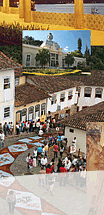
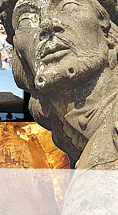
  Ouro Preto Mountains and Joel Prophet (Aleijadinho)

The capital Belo Horizonte

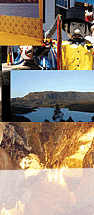
Itatiaia National Park (Itamonte, southern Minas)

The state is also famous for it's food: simple, different, and of course, delicious. To give a few examples: lombinho de porco assado, o tutu de feijao com torresmo e linguica, o feijao tropeiro com couve refogada, a galinha ao molho pardo... And not to forget other delicacies such as: queijo de minas, broa de milho, doce de leite... Rich, traditional, historic: that is the cuisine of Minas, and its recipes can be traced back hundreds of years.

Maquiné grotto (Cordisburgo - MG)  

Distant Times

In 1835, a Dane named Peter W. Lund (1801-80), chose to settle in Minas. By chance or by destiny this man who, besides being a doctor, was a botany and a zoologist built his house on the shore of a lagoon whose water contained special medicinal properties.

The region boasts many caves, such as the now famous Lapinha and Maquiné. These caves were previously largely unexplored and what studies were conducted were largely ignored. We still know very little about the ancient peoples; their beliefs and their way of life. However, Lund gave his contribution so that the history of the area could begin to be told. His incursions through caverns and caves revealed indisputable traces of ancient human habitation. The archaeological site of Lagoa Santa boasts the second oldest archaeological datings in all of Brazil. Lund is considered the father of archaeology in Brazil for his pioneering work on studies of the pleisctocene mastophon of Minas Gerais, for the discovery and study of the "Homen da Lagoa Santa," and for identifying around 150 species of fossilized mammals.

Fumaça Waterfall (Carrancas - MG)

São José de Botas Fountain (Tiradentes - MG)

Cassino do Lago (Lambari - MG)


Cover | Talking About Minas


Support: